

FAO, UM6P deepen climate-smart agriculture
 admin
admin
The Food and Agriculture Organisation of the United Nations and Mohammed VI Polytechnic University (UM6P) are advancing new initiatives aimed at strengthening climate resilience, food security and agricultural innovation in Africa, with major interventions unfolding in Nigeria and Morocco.
In Nigeria, the FAO has launched an ambitious Emergency and Resilience Plan (ERP) for 2026–2028 designed to support millions of vulnerable people facing worsening food insecurity across the country’s conflict- and climate-affected regions.
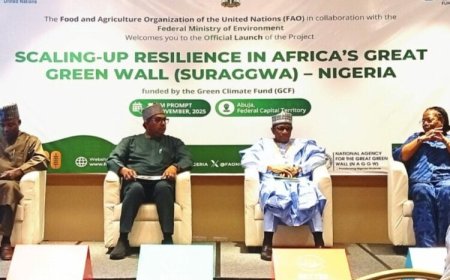
The three-year plan, unveiled in Abuja, seeks to mobilise about $347 million to assist 12.6 million people across the northeast, northwest and north-central zones. The programme targets states including Borno, Adamawa, Yobe and Taraba; Sokoto, Kaduna, Kebbi and Zamfara; as well as Benue, Nasarawa, Niger, Plateau and Kogi.
The initiative comes amid alarming projections that about 34.7 million Nigerians could face crisis or worse levels of acute food insecurity by mid-2026, including more than 5.4 million acutely malnourished children.
According to the FAO, the plan combines emergency agricultural support with long-term resilience strategies to stabilise rural livelihoods, restore food production and reduce reliance on humanitarian food assistance.
“Agriculture is not only a livelihood; it is a life-saving intervention,” Gadain said. “When we support farmers, pastoralists, fishers and agro-processors with timely inputs, services and market access, we protect food production, reduce dependency on food aid, stabilise local markets and create employment, especially for women and youth. This understanding is at the heart of FAO’s Emergency and Resilience Plan for Nigeria for 2026 to 2028.”
The ERP is structured around four pillars that include emergency agricultural assistance to protect rural livelihoods, resilience building to strengthen climate-smart production systems, development of agrifood value chains to create jobs, and improved data systems for early warning and anticipatory action.
Senior Emergency and Rehabilitation Officer at FAO, Dunja Dujanovic, described the programme as a critical intervention at a time when humanitarian needs are increasing while resources are under pressure.
“The Nigeria ERP is a critical contribution at a pivotal time in the country with the planned reduction of the humanitarian footprint within the context of growing food insecurity.It offers solutions which aim to not only address immediate needs but decrease those needs over time,”she said.
Prior to the official launch, FAO held consultations with the Federal Ministry of Agriculture and Food Security, development partners and donors, followed by field visits to project communities and meetings with officials of the Borno State Government.The Nigeria initiative also forms part of FAO’s broader Global Emergency and Resilience Appeal for 2026, a $2.5 billion programme targeting more than 100 million people across 54 countries with rapid agricultural interventions and longer-term resilience investments.
While FAO focuses on emergency response and resilience in Nigeria, Morocco is strengthening the scientific foundation for climate and environmental monitoring.
At its campus in Benguerir, Mohammed VI Polytechnic University has installed a Brewer spectrophotometer through its African Research Center on Air Quality and Climate (ARC_Air) to enhance atmospheric monitoring capabilities.
The ground-based instrument measures atmospheric ozone and ultraviolet radiation by analysing sunlight at specific wavelengths, generating continuous and precise data for environmental monitoring.
Scientists said the system will strengthen the country’s capacity to monitor the ozone layer — located between 15 and 35 kilometres above the Earth’s surface — which absorbs between 97 and 99 per cent of harmful ultraviolet-B radiation.
By enabling long-term atmospheric observation, the initiative is expected to support climate research and environmental policy development across Morocco and the wider African continent.
UM6P is also promoting new thinking on agricultural resilience through research and dialogue. As part of its Green Talks Series, the university’s College of Agriculture and Environmental Sciences hosted a seminar titled “Value Creation in Agriculture: Building Resilience Beyond the Current Model.”
The session, led by Chief Transformation, Innovation and Impact Officer at UM6P, Lotfi Belmahi, explored how research, innovation and strategic investment can transform agricultural systems into engines of economic and environmental resilience.
Belmahi highlighted the importance of aligning scientific knowledge with policy frameworks and private-sector participation to create sustainable agricultural value chains.
Participants at the seminar stressed that addressing climate change, food insecurity and rural poverty will require stronger collaboration between governments, research institutions, investors and development partners.
FAO, UM6P deepen climate-smart agriculture - The Nation Newspaper