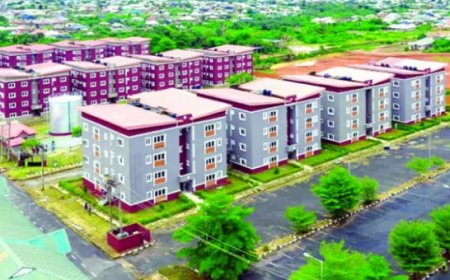


Pension funds at N20trn could transform Nigeria’s housing market – Experts
 admin
admin

Nigeria’s pension assets, now exceeding N20 trillion, could play a transformative role in addressing the country’s estimated 20 to 28 million housing deficit, according to industry experts.
Data from the National Pension Commission (PenCom) show that total net pension assets crossed the N20 trillion mark as of late 2025.
Analysts argue that a carefully structured reallocation of a small portion of these long-term funds into housing instruments could unlock large-scale affordable home development.
With mortgage financing still shallow and commercial lending rates above 25%, developers say access to affordable, long-tenor capital remains the biggest barrier to scaling housing supply.
Currently, less than 3% of total pension assets are invested in real estate-related instruments, with most funds concentrated in Federal Government securities, money market instruments, and equities. Even a modest shift in allocation, experts contend, could significantly reshape the housing landscape.
What they are saying
Housing advocates and financial analysts say pension funds are structurally suited to finance long-term housing projects, provided risks are properly managed. They note that pension assets, by design, seek stable and predictable returns over extended periods.
- “If just five percent of pension assets, roughly N1 trillion, were channelled into well-structured housing instruments, it could finance hundreds of thousands of homes. The key is structuring the risk properly,” said Lanre Bakare, a Lagos-based macroeconomic analyst.
- “Land and materials are expensive, but financing is the real bottleneck. We borrow at double-digit rates, which automatically push up house prices beyond affordability for most Nigerians,” said Architect Simeon Kemakolam, CEO of Grand Spaces Architects Limited.
- Theodore Omokpo, chief executive of Dornesi Projects, stated: “With the right guarantees and governance framework, pension assets can safely support large-scale housing delivery without compromising contributors’ funds.”
- Gloria Ojei, an Abuja-based estate developer, added: “Pension funds, with their long investment horizon, are ideal for funding 15- to 25-year housing projects. If even a small percentage is allocated, we could dramatically increase supply and bring down costs.”
The consensus among industry stakeholders is that long-term capital is the missing link in Nigeria’s housing finance ecosystem.
More Insights
Nigeria’s mortgage market remains one of the shallowest globally, limiting homeownership growth. The country’s mortgage-to-GDP ratio stands at about 0.5%, far below peers such as Kenya at 2.2%, Tunisia at 10.2%, and Namibia at 18.9%, while South Africa exceeds 30% and developed economies surpass 60%.
- High interest rates and short loan tenors have constrained mortgage expansion.
- Limited refinancing mechanisms reduce banks’ appetite for long-term housing loans.
- The Federal Mortgage Bank of Nigeria continues to provide National Housing Fund-backed loans, but funding capacity falls short of national demand.
Pension funds, given their long-dated liabilities, are structurally aligned with housing finance instruments such as mortgage-backed securities, housing infrastructure bonds, and real estate investment trusts that require 10- to 25-year capital commitments.
What this means
Economists say unlocking pension capital for housing could generate macroeconomic gains beyond shelter provision. The construction sector has one of the highest employment multipliers in the Nigerian economy.
- Large-scale housing development would stimulate demand for cement, steel, paints, tiles, and other building materials.
- Small and medium-sized enterprises linked to construction could see increased activity.
- “Every 100,000 housing units built could create hundreds of thousands of direct and indirect jobs; it is a growth engine,” said Dr. Afolabi Yusuf, a Lagos-based development economist.
However, labour groups and contributors urge caution, stressing that pension savings are retirement funds, not intervention capital. “We cannot risk pensioners’ money on poorly structured projects,” said Emeka Okoye, a Lagos-based civil servant and pension contributor.
What you should know
Nigeria’s housing deficit continues to widen amid rapid urbanisation and annual population growth exceeding 2.5%. At the same time, commercial bank lending rates remain elevated, making affordable housing difficult to scale organically.
- Pension assets now exceed N20 trillion, representing one of the largest pools of long-term domestic capital in the country.
- Less than 3% of these assets are currently allocated to real estate-related investments.
- Even a 5% allocation could unlock roughly N1 trillion for housing finance, subject to regulatory approval and risk safeguards.
Against this backdrop, pension capital stands out as one of the few viable domestic funding sources capable of transforming Nigeria’s housing market, provided governance, risk management, and liquidity protections remain firmly in place.
Pension funds at N20trn could transform Nigeria’s housing market - Experts - Nairametrics